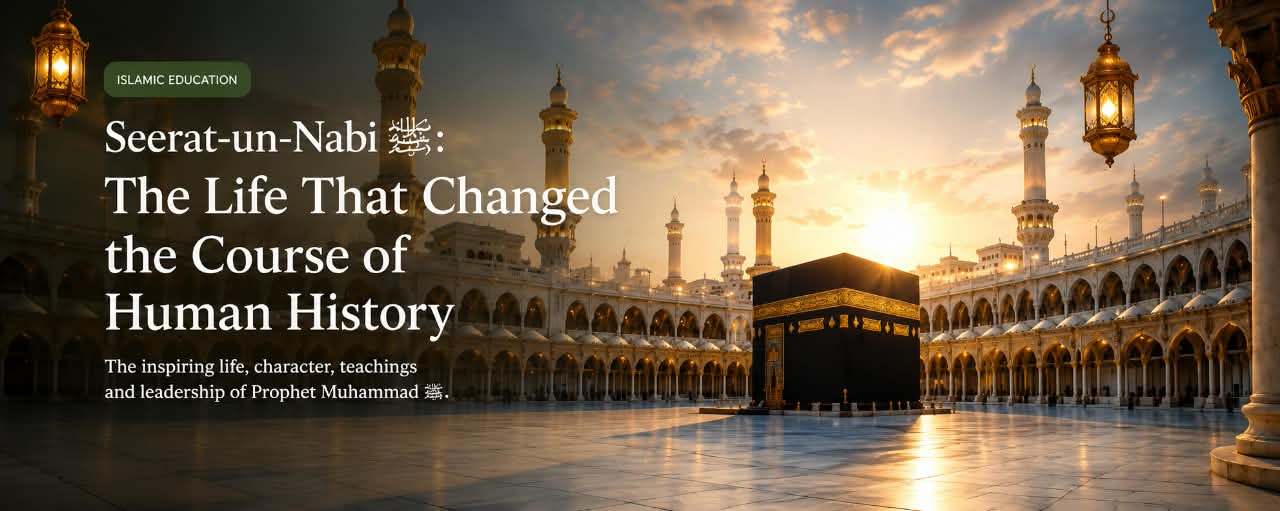
Seerat-un-Nabi ﷺ: The Life That Changed the Course of Human History
Have you ever wondered what the world was like before the arrival of Prophet Muhammad ﷺ?
There was a time when humanity was surrounded by darkness, injustice, cruelty, and ignorance. Powerful rulers oppressed the weak, social status determined a person’s worth, and women and children were often denied their basic rights. The world desperately needed guidance, mercy, justice, and light.
Then, in the deserts of Arabia, a child was born whose life would change the course of human history forever.
That child was Prophet Muhammad ﷺ, the final Messenger of Allah.
His life was not merely the story of a great leader. It was a complete example of faith, mercy, courage, patience, justice, forgiveness, and devotion to Allah. Through his blessed character and teachings, humanity was given a path from darkness towards light.
The study of his life, known as Seerat-un-Nabi ﷺ, remains one of the most important journeys for every Muslim.
The World Before the Arrival of Islam
Before the coming of Prophet Muhammad ﷺ, much of the world was experiencing a period often described in Islamic history as an age of ignorance.
Arab society was divided by tribal pride and social class. The powerful could oppress the weak, slavery was widespread, and many people worshipped idols. Tribal conflicts continued for generations, sometimes over small disputes.
Women were frequently deprived of rights and dignity. Some Arab tribes even practised the horrifying custom of burying infant daughters alive.
Humanity needed a moral revolution.
People needed someone who could teach them that wealth does not make a person superior, that power does not give someone the right to oppress others, and that every human being deserves justice and dignity.The world needed divine guidance.
The Birth of Prophet Muhammad ﷺ
In the city of Makkah, Prophet Muhammad ﷺ was born into the respected tribe of Quraysh.
However, his life began with hardship. He was born without his father, Abdullah, who had passed away before his birth. Later, while he was still a child, he also lost his beloved mother, Amina.
The child who would one day guide millions experienced orphanhood from an early age.
Yet Allah had chosen this orphan child for a mission greater than anything the world had ever witnessed.
He would become a Prophet, a teacher, a leader, a husband, a father, a commander, and above all, the Messenger of Allah ﷺ.
From an Orphan Child to the Mercy for Mankind
The journey of Prophet Muhammad ﷺ teaches us something extraordinary.
Greatness is not dependent on wealth, family status, or worldly power.
Although he began his life as an orphan, Allah raised him to become the most influential human being in history.
Allah sent Prophet Muhammad ﷺ as a mercy for humanity.
His character was marked by kindness and compassion. He cared for children, helped the poor, honoured women, showed kindness to servants, and treated people with respect.
Even those who opposed him could not deny his honesty and trustworthiness. Before receiving Prophethood, he was known among his people as Al-Sadiq and Al-Amin — the Truthful and the Trustworthy.
His life showed humanity what true greatness looks like.
The First Revelation: A New Light for Humanity
When Prophet Muhammad ﷺ reached the age of forty, he would often spend time in contemplation and worship.
Then came the moment that changed history.
In the Cave of Hira, Angel Jibreel عليه السلام came to him with the first revelation from Allah.
The first command was:
“Iqra” — Read.
This was the beginning of the final divine message.
The Prophet ﷺ was given the responsibility of calling humanity towards the worship of one Allah.
His message was simple yet revolutionary:
– Worship Allah alone.
– Speak the truth.
– Help the poor.
– Care for orphans.
– Respect women.
– Establish justice.
– Show mercy.
– Avoid oppression.
– Prepare for the Hereafter.
This message challenged the beliefs and power structures of Makkah.
But Prophet Muhammad ﷺ remained patient and steadfast.
The Pain and Patience of Taif
One of the most emotional chapters in the Seerah is the journey to Taif.
When the people of Makkah continued to reject and persecute him, the Prophet ﷺ travelled to Taif hoping that its people would listen to the message of Allah.
Instead, he faced rejection and cruelty.
He was insulted, mocked, and physically harmed. According to the well-known accounts of the Seerah, stones were thrown at him until he was injured.
Yet, despite this painful experience, Prophet Muhammad ﷺ did not respond with revenge.
His response showed the depth of his mercy.
The lesson of Taif teaches Muslims that strength is not always about defeating others. Sometimes, the greatest strength is patience, forgiveness, and continuing to do what is right even when people hurt you.
The Night of Badr: Faith Against All Odds
The Battle of Badr was another defining moment in Islamic history.
The Muslims were few in number and faced a much larger and better-equipped army.
From a worldly perspective, the situation appeared extremely difficult.
Yet the believers placed their trust in Allah.
The events of Badr remind us that success does not depend only on numbers, wealth, or power. Faith, preparation, courage, and reliance upon Allah are also essential.
It was a moment that strengthened the Muslim community and became one of the most important events in the early history of Islam.
The Conquest of Makkah and the Power of Forgiveness
Perhaps one of the greatest examples of the Prophet’s ﷺ mercy was seen during the Conquest of Makkah.
For years, he and his followers had faced persecution, insults, boycotts, violence, and exile.
Eventually, the Prophet ﷺ returned to Makkah in a position of strength.
This was the moment when he could have taken revenge.
But he chose forgiveness.
Instead of responding to years of hostility with cruelty, he showed mercy.
This moment remains a powerful lesson for humanity.
Real power is not always demonstrated through revenge. Sometimes, the greatest victory is having the power to punish but choosing to forgive.
Prophet Muhammad ﷺ and Human Equality
One of the revolutionary teachings of Islam was the principle of human equality.
In a society where tribal identity and social status often determined a person’s position, Prophet Muhammad ﷺ taught that superiority is not based on race, wealth, nationality, or family background.
Human beings are equal in their basic dignity.
The true measure of a person’s worth is their righteousness and relationship with Allah.
This message broke social barriers and gave dignity to people who had previously been ignored or oppressed.
The Seerah teaches us that racism, arrogance, and pride have no place in the heart of a true believer.
Why Is Learning Seerat-un-Nabi ﷺ Important Today?
Many Muslims know individual events from the life of Prophet Muhammad ﷺ. We may know about his birth, the first revelation, the Hijrah, the Battle of Badr, or the Conquest of Makkah.
But knowing individual stories is different from truly understanding his life.
The Seerah helps us understand:
– How the Prophet ﷺ dealt with hardship.
– How he treated his family.
– How he responded to enemies.
– How he cared for the poor.
– How he led a community.
– How he worshipped Allah.
– How he remained patient during difficulties.
– How he forgave people.
– How he built a society based on faith and justice.
For a Muslim, learning about the Prophet ﷺ should not be limited to history.
It should be a journey of love, understanding, and transformation.
Bringing the Seerah into Our Daily Lives
The ultimate purpose of studying Seerat-un-Nabi ﷺ is not simply to gain information.
It is to change ourselves.
We should ask ourselves:
How can I become more honest?
How can I be more patient?
How can I forgive others?
How can I treat my parents, spouse, children, neighbours, and friends better?
How can I become more connected to Allah?
The more we learn about Prophet Muhammad ﷺ, the more we should try to bring his beautiful teachings into our lives.
His Seerah should be reflected in our words, behaviour, relationships, and decisions.
Teaching the Seerah to Our Children
Children need heroes.
In today’s world, children are surrounded by celebrities, fictional characters, and social media influencers.
But the greatest role model for a Muslim child is Prophet Muhammad ﷺ.
Parents and teachers should introduce children to the life and character of the Prophet ﷺ in a way that inspires love.
They should learn about:
– His kindness towards children.
– His honesty.
– His courage.
– His love for Allah.
– His mercy towards others.
– His patience during hardship.
– His respect for women and the elderly.
– His forgiveness.
– His beautiful character.
When children develop a love for Prophet Muhammad ﷺ, his teachings can become a source of guidance throughout their lives.
The Seerah Is More Than History
The life of Prophet Muhammad ﷺ is not an ordinary historical story.
It is the story of a man who transformed hearts, communities, and civilizations through the guidance of Allah.
From an orphan child in Makkah to the leader of a growing Muslim community in Madinah, his journey contains lessons for every stage of life.
The Seerah gives hope to the person experiencing hardship.
It gives patience to the person facing difficulties.
It gives courage to the person standing for truth.
It gives mercy to the person who has the opportunity to take revenge.
And it gives guidance to anyone searching for a better way to live.
Conclusion
The arrival of Prophet Muhammad ﷺ was a turning point in human history.
He came at a time when humanity desperately needed divine guidance. Through his message and character, people were called from ignorance towards knowledge, from oppression towards justice, and from darkness towards light.
For Muslims, loving Prophet Muhammad ﷺ means more than simply knowing his name or celebrating important moments from his life.
It means learning about him.
It means understanding his message.
It means following his example.
And it means making his teachings part of our daily lives.
The journey of Seerat-un-Nabi ﷺ is a journey of faith, love, knowledge, and transformation.
It is not simply about looking back at history.
It is about allowing the light of the Prophet’s ﷺ teachings to guide our present and future.
Indeed, for every Muslim, knowing and loving the Messenger of Allah ﷺ is one of the most beautiful and important journeys of life.
Frequently Asked Questions
What is Seerat-un-Nabi ﷺ?
Seerat-un-Nabi ﷺ refers to the biography, life, character, teachings, and major events associated with Prophet Muhammad ﷺ.
Why should Muslims study the Seerah?
Studying the Seerah helps Muslims understand the life, character, struggles, teachings, and example of Prophet Muhammad ﷺ and apply those lessons in their daily lives.
What can we learn from the life of Prophet Muhammad ﷺ?
We can learn honesty, patience, forgiveness, mercy, courage, justice, humility, leadership, and devotion to Allah.
How can children learn about Seerat-un-Nabi ﷺ?
Children can learn through age-appropriate stories, Islamic classes, books, videos, family discussions, and lessons that focus on the Prophet’s ﷺ beautiful character and teachings.
How can we follow the example of Prophet Muhammad ﷺ?
We can begin by learning his teachings and trying to apply them in our behaviour, worship, relationships, honesty, kindness, patience, and treatment of others.
Related Posts
https://onlinequranclassesforkids.com/12th-rabi-ul-awwal-the-day-that-changed-the-course-of-human-history/