
From Dhaka to Makkah: How One Young Hafiz Won a World Qur'an Championship
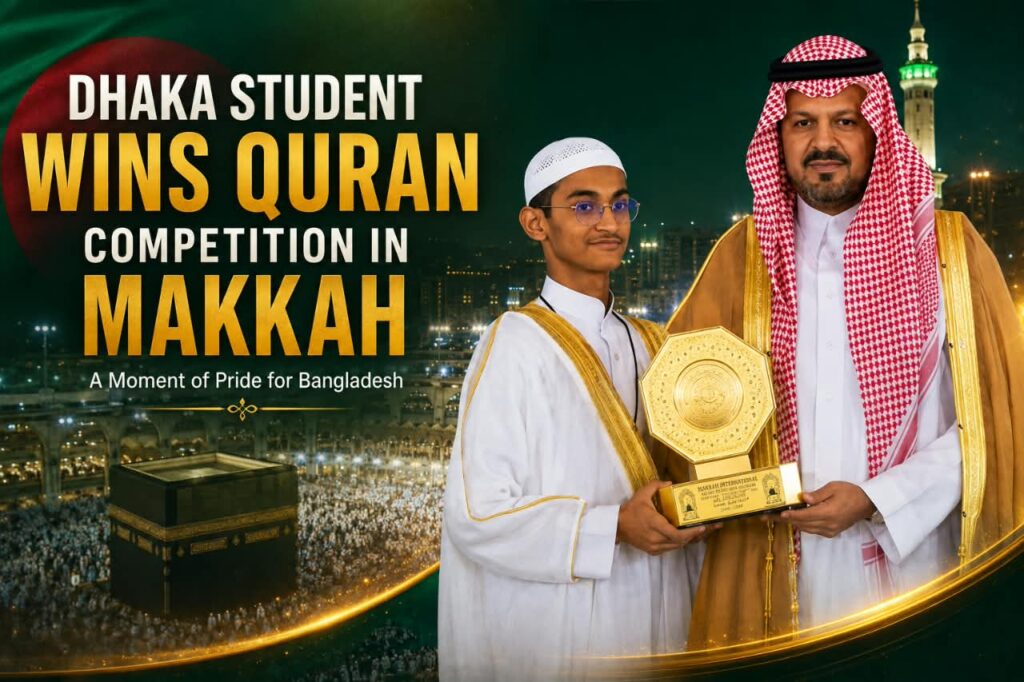
Every year, thousands of students around the world spend years memorising the Qur’an in the hope of one day competing on an international stage. This August in Makkah, one of them — a young Hafiz from Dhaka named Nuruddin Zakaria — reached the top.
Zakaria won first place in the fourth category of the 46th King Abdulaziz International Competition for Memorizing, Reciting, and Interpreting the Holy Qur’an, an event widely regarded as one of the most demanding Qur’an competitions in the world.
The Scale of the Competition
Organised by Saudi Arabia’s Ministry of Islamic Affairs, Dawah and Guidance, the King Abdulaziz competition is held annually in the holy city of Makkah. This year’s edition set a new bar for size: 334 male and female contestants travelled from 133 countries to take part across five separate categories, each testing a different level of memorisation, recitation, and Qur’anic scholarship.
Winning first place in any category at this scale is an achievement. Doing it as a student from a single madrasa in Dhaka, competing against Hafiz from across the Muslim world, made Zakaria’s win a genuine standout moment for Bangladesh.
Inside the Fourth Category
Zakaria’s category required him to have fully memorised 15 consecutive Juz of the Qur’an — nearly half the entire text — and to recite it under the scrutiny of expert judges. The judging criteria covered:
Precision of memorisation, with no room for error
Clear, correct pronunciation
Mastery of Tajweed rules
Composure and fluency under pressure
Reaching first place meant clearing multiple rounds of this evaluation, a process that tests not just memory but discipline built over years of study.
A Student's Journey, Not an Overnight Win
Zakaria studies at Ar Rayhan International Madrasa in Dhaka, and his win didn’t happen in isolation — it’s the product of a long educational path that likely started with the basics: learning Arabic pronunciation through Noorani Qaida, building up Tajweed skills, and gradually memorising the Qur’an Juz by Juz under a qualified teacher’s guidance.
That’s the part of the story worth highlighting for other students and parents: the trophy is the visible result, but the years of quiet, consistent revision behind it made the win possible.
A Father's Sacrifice Behind the Win
Behind Zakaria’s victory is a story of quiet sacrifice. His father reportedly earned a modest living selling milk from the family’s cows, and to cover his son’s travel and other expenses for the competition, he sold the cows themselves. That decision — giving up his livelihood to help his son reach Makkah — became part of the journey that ended in an extraordinary international achievement.
Why This Matters Beyond One Competition
nternational Qur’an competitions like this one exist to do more than reward a single winner. They give students across dozens of countries a shared goal, connect them with peers they’d otherwise never meet, and keep the tradition of memorisation alive across generations.
For Zakaria, the win in Makkah is a milestone. But as many Qur’an teachers point out, the real success isn’t finishing first — it’s staying connected to the Qur’an for life, long after the competition ends.
FAQ
Who won the 46th King Abdulaziz International Qur'an Competition's fourth category?
Nuruddin Zakaria, a Bangladeshi student at Ar Rayhan International Madrasa in Dhaka.
What does the fourth category require?
Memorisation of 15 consecutive Juz of the Qur’an, judged alongside recitation accuracy and Tajweed.
How big was the 2026 competition?
334 contestants from 133 countries competed across five categories in Makkah, Saudi Arabia.
Who organises the competition?
Saudi Arabia’s Ministry of Islamic Affairs, Dawah and Guidance.