
sayyidul istighfar dua
Sayyidul Istighfar Dua (سَيِّدُ الِاسْتِغْفَارِ) is one of the most comprehensive duas for seeking forgiveness from Allah. The Prophet Muhammad ﷺ taught this beautiful supplication to his companions and described it as the best way of asking Allah for forgiveness.
In this guide, you will find the Sayyidul Istighfar Dua in Arabic, English transliteration, English translation, its meaning, hadith reference, benefits, recommended time to recite it, and an audio section to help you learn and recite it correctly.
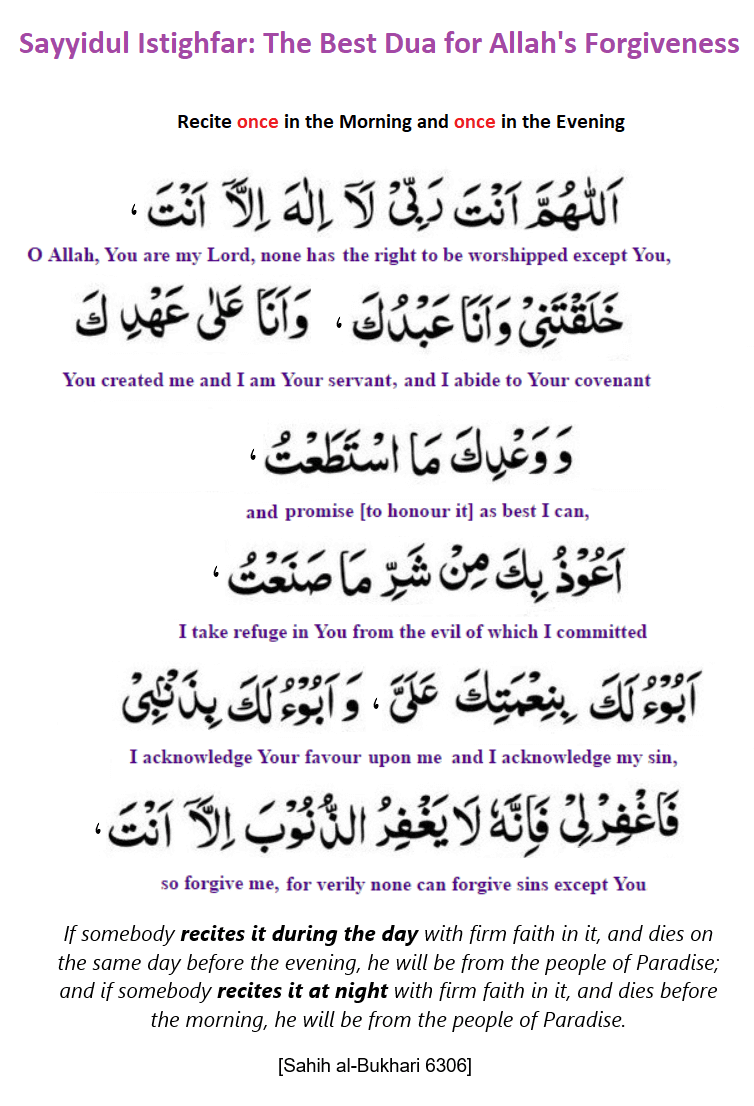
Sayyidul Istighfar Dua in Arabic
Sayyidul Istighfar Dua Audio
Listening to the audio while following the Arabic text can help you learn the correct pronunciation. You can also listen to it regularly and then recite the dua yourself.
Sayyidul Istighfar Transliteration
Allahumma anta Rabbi, la ilaha illa anta, khalaqtani wa ana ‘abduka, wa ana ‘ala ‘ahdika wa wa’dika mastata’tu, a’udhu bika min sharri ma sana’tu, abu’u laka bini’matika ‘alayya, wa abu’u laka bidhanbi, faghfir li, fa innahu la yaghfirudh-dhunuba illa anta.
If you are learning the dua, try to listen to the audio and repeat each part slowly.
Sayyidul Istighfar Translation
O Allah, You are my Lord. There is no god worthy of worship except You. You created me, and I am Your servant. I remain faithful to Your covenant and promise as much as I am able. I seek refuge in You from the evil of what I have done. I acknowledge Your blessings upon me, and I acknowledge my sins. So forgive me, for none can forgive sins except You.
This translation reflects the meaning of the supplication narrated in Sahih al-Bukhari.
What Dose Sayyidul Istighfar Mean?
The Arabic phrase Sayyidul Istighfar means “the master of seeking forgiveness.”
The dua combines several important meanings:
Recognizing Allah as your Lord
Declaring that only Allah deserves worship
Acknowledging that Allah created you
Recognizing your position as His servant
Acknowledging Allah’s blessings
Admitting your sins
Seeking protection from the consequences of your wrongdoing
Asking Allah for forgiveness
Because of these comprehensive meanings, the Prophet ﷺ described it as the best way of seeking forgiveness.
Hadith About Sayyidul Istighfar Mean?
Sayyidul Istighfar is narrated in Sahih al-Bukhari, Hadith 6306, from Shaddad ibn Aws رضي الله عنه.
The Prophet Muhammad ﷺ taught this supplication and said that whoever recites it during the day with firm faith and dies before evening will be among the people of Paradise. Likewise, whoever recites it at night with firm faith and dies before morning will be among the people of Paradise.
Reference: Sahih al-Bukhari 6306, Book of Invocations.
Benefits Of Sayyidul Istighfar
It is a powerful dua for forgiveness
The central purpose of Sayyidul Istighfar is to ask Allah to forgive our sins.
The final words of the dua are a direct request for forgiveness and acknowledge that Allah alone forgives sins.
It teaches us to acknowledge our sins
The dua does not only ask for forgiveness. It also teaches a believer to acknowledge his or her mistakes and turn back to Allah sincerely.
It reminds us of Allah's blessings
The supplication includes an acknowledgment of Allah’s blessings. This teaches us to combine gratitude with repentance.
It strengthens our relationship with Allah
The opening of the dua recognizes Allah as our Lord and acknowledges that there is no deity worthy of worship except Him.
It is an excellent daily practice
Making Sayyidul Istighfar part of your daily routine can help you regularly remember Allah and seek His forgiveness.
When Should You Recite Sayyidul Istighfar?
The hadith mentions reciting Sayyidul Istighfar during the day and at night.
A simple routine is:
Morning: Recite Sayyidul Istighfar after waking up or during your morning adhkar.
Evening: Recite it during your evening adhkar.
The important point is to recite it with sincere faith and understanding, rather than simply repeating the words without attention to their meaning. The specific virtue mentioned in the hadith is connected with reciting it with firm conviction.
How to Memorize Sayyidul istighfar
If you find the complete dua difficult to memorize, divide it into small sections.
Part 1
Allahumma anta Rabbi, la ilaha illa anta
Part 2
Khalaqtani wa ana ‘abduka
Part 3
Wa ana ‘ala ‘ahdika wa wa’dika mastata’tu
Part 4
A’udhu bika min sharri ma sana’tu
Part 5
Abu’u laka bini’matika ‘alayya
Part 6
Wa abu’u laka bidhanbi
Part 7
Faghfir li, fa innahu la yaghfirudh-dhunuba illa anta
Listen to the audio, repeat one section several times, and then gradually join the sections together.
Sayyidul istighfar for kids
Parents can also teach Sayyidul Istighfar to children as part of their daily Islamic routine.
For younger children, start with:
1 Listening to the audio
2 Repeating one short section at a time
3 Learning the Arabic gradually
4 Understanding the simple meaning
5 Practicing it every morning and evening
Learning duas from childhood can help children develop a regular habit of remembering Allah.
Sayyidul Istighfar vs. Astaghfirullah
Astaghfirullah means:
أَسْتَغْفِرُ اللَّهَ
“ I seek forgiveness from Allah.”
Sayyidul Istighfar is a much longer and more comprehensive supplication. It includes seeking forgiveness while also acknowledging Allah’s lordship, blessings, our servitude, and our sins.
Both are forms of seeking forgiveness, but Sayyidul Istighfar has a specific wording taught by the Prophet ﷺ and is specifically described in the hadith as the best way of seeking forgiveness.
Frequently Asked Questions
What is Sayyidul Istighfar?
Sayyidul Istighfar is a comprehensive dua for seeking Allah’s forgiveness taught by Prophet Muhammad ﷺ and recorded in Sahih al-Bukhari 6306.
What is the meaning of Sayyidul Istighfar?
Sayyidul Istighfar means “the master of seeking forgiveness.”
When should I read Sayyidul Istighfar?
The hadith mentions reciting it during the day and at night. Many Muslims include it in their morning and evening adhkar.
How many times should I recite Sayyidul Istighfar?
The hadith specifically mentions reciting it during the day or night; it does not prescribe a general requirement to repeat it a particular number of times. You can include it in your daily morning and evening routine.
Can children learn Sayyidul Istighfar?
Yes. Children can learn it gradually by listening to the audio, repeating short sections, and learning the meaning.
Is Sayyidul Istighfar authentic?
Yes. The supplication is narrated in Sahih al-Bukhari, Hadith 6306, from Shaddad ibn Aws رضي الله عنه.
Make Sayyidul Istighfar Part of Your Daily Routine
Sayyidul Istighfar is a beautiful reminder that a believer should recognize Allah’s blessings, acknowledge personal shortcomings, and continually turn back to Allah.
Take a few moments each morning and evening to read the dua carefully, listen to its audio if you are still learning it, understand its meaning, and recite it sincerely.
May Allah forgive our sins, accept our repentance, and make us among those who constantly remember Him. Ameen.
Hadith Reference
Sahih al-Bukhari 6306 – Book of Invocations
Narrated by Shaddad ibn Aws رضي الله عنه.
Really enjoyed reading “sayyidul istighfar dua” — the details made it easy to picture.
SubhanAllah! ❤️ This is such a beautiful and powerful dua. JazakAllahu Khairan for sharing this beneficial reminder. May Allah forgive our sins, accept our sincere repentance, and grant us Jannah. Ameen. 🤲